At the opening of the play
Theatrical Invitation
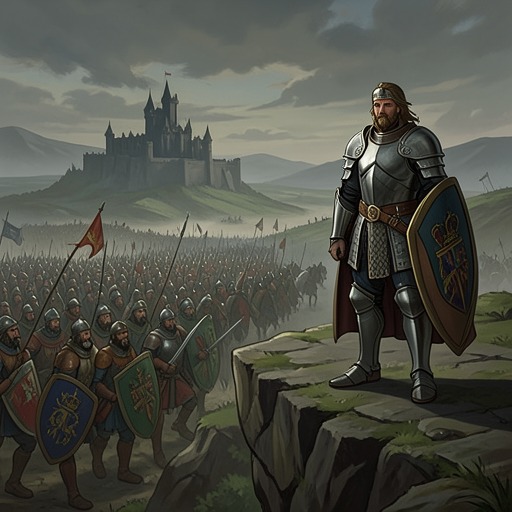
[Chorus](entity:character-recall-character-chorus-57c583e6da0c) asks the audience to imagine a grander stage than the wooden theater can provide: armies, monarchies, and the fields of [France](entity:location-recall-location-france-f5cafc8a8ad4) must be assembled in the mind. The appeal establishes that the history will leap across places and years, relying on spectators to complete what the stage cannot show.
The Chorus asks for patient listening and generous judgment, making the audience an active partner in the telling. This framing returns throughout the play whenever the action outruns the theater’s limited space.
Before the French campaign
The Church’s Threatened Lands
In the palace, the [Archbishop of Canterbury](entity:character-recall-character-4b5dfb6016b2) tells the [Bishop of Ely](entity:character-recall-character-6006b8b53c05) that the [English Commons](entity:organization-recall-organization-english-commons-8adaa373aab0) may pass a bill stripping the [English Church](entity:organization-recall-organization-english-church-b829abb5e4ba) of much of its property. He estimates that the confiscated wealth could support a large force of nobles and soldiers, aid the poor, and add money to the royal treasury.
The bishops consider how to avert the measure. Canterbury says he has offered the king a substantial clerical contribution toward the French enterprise, linking the church’s financial self-interest to the coming war.
Before the French campaign, after his father’s death
The King’s Transformation
Canterbury describes [King Henry V](entity:character-recall-character-06a7e982e93d) as having changed abruptly after his father’s death. The disorderly prince, he says, became a grave and able ruler, capable of reasoning on religion, government, and war with extraordinary command.
Ely compares the transformation to wholesome berries growing beneath nettles, suggesting that Henry’s former wildness concealed an intelligence developing out of sight. Their praise offers a flattering explanation of the king’s past while serving the bishops’ present political needs.
Before the French campaign, at the royal council
The French Succession Claim
Before receiving the French ambassador, [King Henry V](entity:character-recall-character-06a7e982e93d) asks Canterbury to explain whether [Salic Law](entity:rule-recall-rule-salic-law-027cb0abb9b4) bars his claim to the French crown. He warns the archbishop not to twist the law to suit royal ambition, because a mistaken argument could cost many lives.
Canterbury argues that Salic Law concerned a territory in [Germany](entity:location-recall-location-germany-2e3723c2f347), not [France](entity:location-recall-location-france-f5cafc8a8ad4), and points to French precedents in which inheritance passed through women. He cites the Bible’s daughters’ inheritance rule and declares that the English claim descends from Edward III through a female line.
At the same royal council
The Risk from Scotland
The council weighs the danger that [Scotland](entity:location-recall-location-scotland-4e112aa71aa3) might invade while English forces are abroad. [King Henry V](entity:character-recall-character-06a7e982e93d) recalls earlier French campaigns during which the Scots attacked an under-defended [England](entity:location-recall-location-england-b153c1f368ea), and he insists that the threat is more serious than border raiding.
Canterbury argues that England can divide its functions without losing unity. He compares the kingdom to [Honey bees](entity:creature-recall-creature-honey-bees-f9bcaf13a2a6), whose different workers serve one common purpose, and urges the king to take a portion of the country’s strength to [France](entity:location-recall-location-france-f5cafc8a8ad4) while the rest protects home.
At the royal council, before the French embassy
The Council Backs War
Canterbury and the nobles press [King Henry V](entity:character-recall-character-06a7e982e93d) to act on his inherited claim, invoking [England](entity:location-recall-location-england-b153c1f368ea)’s past victories and the king’s youth and military promise. Canterbury also offers the clergy’s extraordinary financial support for the expedition.
The king says the country must prepare both to invade [France](entity:location-recall-location-france-f5cafc8a8ad4) and to defend itself. After hearing the argument, he declares himself resolved to pursue the claim, with victory or death as the possible outcomes, and orders that the French representatives be admitted.
At the French embassy, before the invasion
The Tennis-Ball Insult
The French ambassador reports that the [Dauphin](entity:character-recall-character-c502c590b767) mocks [King Henry V](entity:character-recall-character-06a7e982e93d) as an irresponsible youth and advises him that French dukedoms cannot be won by youthful pleasures. As a pointed answer to Henry’s claims, the Dauphin sends him tennis balls.
Henry accepts the insult with controlled anger, promising that his future play in [France](entity:location-recall-location-france-f5cafc8a8ad4) will turn the balls into cannon shot and bring grief to French families. He tells the ambassador that the jest has transformed his purpose into vengeance, making the exchange a public provocation for war.
Soon after the tennis-ball insult
The Campaign Begins
After the ambassador departs, [King Henry V](entity:character-recall-character-06a7e982e93d) orders his lords to accelerate preparations for the French expedition. He says that [France](entity:location-recall-location-france-f5cafc8a8ad4) is now his only earthly concern, apart from what must be entrusted to God.
The exchange of claims and insults has become an armed undertaking. The king’s decision puts the [English army](entity:organization-recall-organization-english-army-b32beb8e94a9) on the path from [Southampton](entity:location-recall-location-southampton-f8a0f0273801) toward France and turns a disputed inheritance into a campaign with consequences for both kingdoms.
During preparations at London
The Old Companions Gather
In [London](entity:location-recall-location-london-420923d4a60a), [Corporal Nym](entity:character-recall-character-6faf9d226661) and [Lieutenant Bardolph](entity:character-recall-character-66d7ebb3e459) argue over [Ancient Pistol](entity:character-recall-character-06c98932720d), who has married [Hostess Quickly](entity:character-recall-character-55a20a29395a) despite Nym’s former understanding with her. Their quarrel threatens to turn into a fight, but Bardolph persuades them to make peace because they are all heading to [France](entity:location-recall-location-france-f5cafc8a8ad4).
The reconciliation is practical rather than noble: Pistol offers money and the prospect of profit from his work as a camp sutler. The scene shows the ordinary, opportunistic life that accompanies the grand royal campaign.
Before the English army sails from Southampton
Falstaff’s Death
[Hostess Quickly](entity:character-recall-character-55a20a29395a) tells Bardolph, Nym, Pistol, and the [Boy](entity:character-recall-character-41c88b6c1845) that [Sir John Falstaff](entity:character-recall-character-b8ba3fdd6c6e) has died after an illness. She recalls his confused final hours, describing his cold limbs, his talk of green fields, and his last cries.
The account closes the thread of Henry’s former companions before the army leaves for [France](entity:location-recall-location-france-f5cafc8a8ad4). Their grief is mixed with vulgar humor and practical concerns, while Falstaff’s absence marks how completely the king’s life has moved away from his old company.
At Southampton, before the invasion
The Southampton Conspiracy
As the fleet prepares to sail, the [Chorus](entity:character-recall-character-chorus-57c583e6da0c) reveals that [Richard Earl of Cambridge](entity:character-recall-character-c3fedaad4cf0), [Henry Lord Scroop of Masham](entity:character-recall-character-0a83a0225fd7), and [Sir Thomas Grey](entity:character-recall-character-8f9af2ae5d2f) have accepted French money and plotted against [King Henry V](entity:character-recall-character-06a7e982e93d). Their betrayal threatens the king’s life before the campaign has even reached [France](entity:location-recall-location-france-f5cafc8a8ad4).
The conspiracy is especially shocking because Scroop has enjoyed Henry’s trust and favor. The plot makes the expedition’s first danger an internal one, testing the king’s judgment before the enemy can test his army.
At Southampton, after the conspiracy is discovered
The King Tests the Conspirators
[King Henry V](entity:character-recall-character-06a7e982e93d) meets the suspected traitors without first disclosing that their plot has been uncovered. He pardons a drunken man who had insulted him, prompting Cambridge, Scroop, and Grey to urge punishment in the name of security and good government.
The king then reveals the evidence and turns their own argument against them. His anger focuses particularly on Scroop, whose apparent loyalty and access to Henry’s confidence make the betrayal feel like a personal violation as well as treason.
At Southampton, immediately after their exposure
The Traitors’ Execution
The conspirators acknowledge their guilt and ask for pardon, but [King Henry V](entity:character-recall-character-06a7e982e93d) distinguishes personal forgiveness from the safety of the kingdom. He delivers them to the law for conspiring to kill him and to expose the country to desolation.
After the traitors are taken away, Henry treats the discovery as a sign that God has cleared the way for the campaign. He orders the expedition forward, though the execution does not erase the moral uncertainty surrounding the war’s larger purpose.
As the English expedition approaches France
The French Prepare
At the French court, the [King of France](entity:character-recall-character-0d758912dc80) orders his nobles to strengthen the towns and prepare the defenses. The [Dauphin](entity:character-recall-character-c502c590b767) dismisses [King Henry V](entity:character-recall-character-06a7e982e93d) as shallow and unfit to rule, but the [Constable of France](entity:character-recall-character-d7125834e961) warns that the king’s former wildness may have concealed deliberate judgment.
The French King recalls the earlier English victories associated with Edward III and the Black Prince. His caution contrasts with the Dauphin’s contempt, while the French court recognizes that the approaching English force cannot safely be treated as a joke.
At the French court, after the English declaration
France Rejects the Demand
The [Duke of Exeter](entity:character-recall-character-d3ecd1cf28c6) delivers [King Henry V](entity:character-recall-character-06a7e982e93d)’s demand that the French King surrender the crown and its honors, backed by Henry’s genealogical claim. He warns that refusal will bring force and the deaths of those caught in the conflict.
The [Dauphin](entity:character-recall-character-c502c590b767) admits that he sent the tennis balls as an insult and insists that the gesture was meant to provoke [England](entity:location-recall-location-england-b153c1f368ea). The French King delays his full answer until the next day, leaving diplomacy unresolved while the [English army](entity:organization-recall-organization-english-army-b32beb8e94a9) is already on French soil.
At the beginning of the French campaign
The Landing at France
The [Chorus](entity:character-recall-character-chorus-57c583e6da0c) asks the audience to imagine [King Henry V](entity:character-recall-character-06a7e982e93d)’s fleet leaving [Southampton](entity:location-recall-location-southampton-f8a0f0273801) and crossing the sea with soldiers, ships, and artillery. The English force reaches [France](entity:location-recall-location-france-f5cafc8a8ad4) and sets its course for [Harfleur](entity:location-recall-location-harfleur-36327803bed0).
The imagined voyage compresses a major movement of the army into theatrical narration. It also prepares the audience for the siege, where the king’s claim and the [Dauphin](entity:character-recall-character-c502c590b767)’s insult will be tested through violence rather than argument.
During the Siege of Harfleur
Once More Unto the Breach
As English troops assault the walls of [Harfleur](entity:location-recall-location-harfleur-36327803bed0), [King Henry V](entity:character-recall-character-06a7e982e93d) urges them to attack again, presenting battle as a moment when ordinary restraint must give way to determined courage. He calls on the soldiers to honor their ancestors and to prove themselves worthy of their English upbringing.
The speech turns fear into collective identity: the king names the cause, invokes [England](entity:location-recall-location-england-b153c1f368ea) and Saint George, and gives the assault a shared cry. Its energy carries the English forward into the breach, but the siege will soon expose the cost behind its heroic language.
During the assault on Harfleur
The Captains’ Cowardice
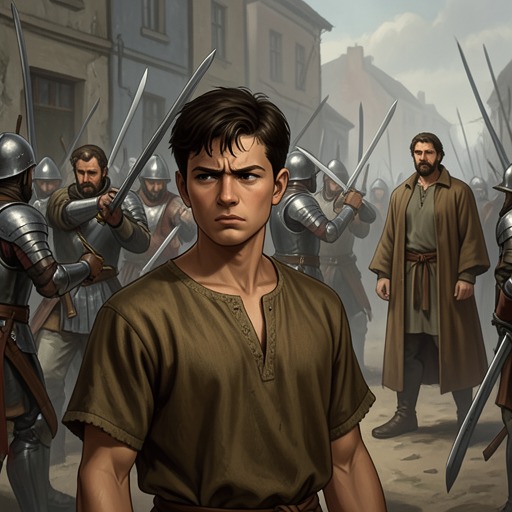
Nym, Bardolph, Pistol, and the [Boy](entity:character-recall-character-41c88b6c1845) hesitate before the dangers at the breach. Fluellen drives the older soldiers onward, while the Boy’s account exposes their pretensions: Bardolph avoids fighting, Pistol boasts more than he acts, and Nym’s supposed reserve conceals few deeds.
The Boy condemns their theft as well as their cowardice and decides to seek better service. His departure gives a sharp view of the gap between the king’s stirring military rhetoric and the conduct of soldiers who hope to profit without sharing the danger.
During the Siege of Harfleur
The Siege Dispute
Fluellen criticizes the mining operation beneath [Harfleur](entity:location-recall-location-harfleur-36327803bed0) and argues with [Captain Macmorris](entity:character-recall-character-d4f78dd6fc4c) about military practice. Their debate is interrupted by the need to return to the breach, while Captain Jamy urges both men toward action.
The encounter mixes professional pride, national difference, and the immediate pressure of battle. It also shows the varied officers serving in the [English army](entity:organization-recall-organization-english-army-b32beb8e94a9), whose disagreements must be subordinated to the siege itself.
At the end of the Siege of Harfleur
Harfleur’s Surrender
[King Henry V](entity:character-recall-character-06a7e982e93d) gives [Harfleur](entity:location-recall-location-harfleur-36327803bed0)’s governor a final choice: surrender or face the consequences of a renewed assault. He describes the horrors that may follow if his soldiers break into the town, including violence against civilians, and makes the defenders responsible for refusing to yield.
The governor explains that the [Dauphin](entity:character-recall-character-c502c590b767) has failed to send relief and offers the town and its people to the king’s mercy. Henry orders the gates opened, instructs the [Duke of Exeter](entity:character-recall-character-d3ecd1cf28c6) to secure Harfleur, and says the sickening [English army](entity:organization-recall-organization-english-army-b32beb8e94a9) will retire toward [Calais](entity:location-recall-location-calais-b214734e8b3e).
After the fall of Harfleur
Katharine Learns English
[Princess Katharine](entity:character-recall-character-e05a1c7fdbe6) asks [Alice](entity:character-recall-character-499fccb3027e) to teach her English words for parts of the body. As Katharine repeats and mispronounces the vocabulary, some words sound indecorous to her, creating a comic lesson in the differences between the languages.
The scene introduces Katharine’s English education before her later meeting with [King Henry V](entity:character-recall-character-06a7e982e93d). Its humor also makes language and cultural misunderstanding part of the play’s approach to the coming marriage alliance.
As the English army advances through France
The French Musters
The French nobles learn that [King Henry V](entity:character-recall-character-06a7e982e93d) has crossed the Somme. They react with anger and shame that a small English force has advanced so far, while the French King calls on the leading princes to take the field.
The French court plans to meet the [English army](entity:organization-recall-organization-english-army-b32beb8e94a9) with overwhelming numbers and sends [Montjoy](entity:character-recall-character-86f1edd49d80) to demand a ransom from Henry. Confidence in French superiority remains strong, even as the English approach the decisive encounter.
During the English march through Picardy
Exeter Holds the Bridge
Fluellen reports that the [Duke of Exeter](entity:character-recall-character-d3ecd1cf28c6) has held a bridge against the French and forced them to withdraw. He praises the defense and its discipline, while acknowledging that the English have lost Bardolph, who is to be executed for robbing a church.
The bridge action secures the army’s route, but Bardolph’s fate shows that Henry’s campaign will enforce order as well as pursue victory. The king rejects a plea for leniency and orders that French civilians and property be treated with restraint.
During the march through France, before Agincourt
Bardolph’s Execution
Pistol asks Fluellen to intervene for Bardolph, presenting the condemned man as a loyal soldier brought down by cruel fortune. Fluellen refuses: theft from a church is an offense that military discipline must punish, even if the accused is his brother.
Henry confirms Bardolph’s sentence and orders his troops not to take or damage French property without payment. His policy makes restraint part of the king’s authority, but it also wounds the old fellowship of the soldiers who once shared a life with Falstaff.
Near Agincourt, before the battle
Montjoy’s First Ransom Demand
[Montjoy](entity:character-recall-character-86f1edd49d80) delivers the French King’s demand that [King Henry V](entity:character-recall-character-06a7e982e93d) pay a ransom proportionate to French losses and accept that the English campaign has failed. Henry replies that his army is weakened by sickness and reduced in number, yet says it will continue toward [Calais](entity:location-recall-location-calais-b214734e8b3e) if unopposed.
Henry refuses to seek a battle but also refuses to avoid one if the French block his way. Montjoy departs with the answer, and Henry entrusts the army to God as it prepares to cross the river and camp.
The night before the Battle of Agincourt
The French Boast Before Battle
In the French camp, the [Dauphin](entity:character-recall-character-c502c590b767) boasts about his horse while the [Constable of France](entity:character-recall-character-d7125834e961) and other nobles trade taunts and jokes. They expect the English to be easy prey, and they ridicule the enemy’s apparent exhaustion and poverty.
Their confidence conceals the danger of underestimating a desperate opponent. As they look toward morning, the French nobles anticipate an easy victory and a large number of English prisoners.
The night before the Battle of Agincourt
A King Among His Soldiers
The [Chorus](entity:character-recall-character-chorus-57c583e6da0c) describes the English camp as exhausted and outnumbered, then follows [King Henry V](entity:character-recall-character-06a7e982e93d) as he moves from tent to tent, greeting soldiers and offering encouragement. His presence gives the men comfort without revealing the full weight of the danger surrounding them.
The Chorus calls this encounter a small touch of Henry in the night: a monarch briefly reaches his soldiers as a fellow countryman and commander. The scene prepares the contrast between royal ceremony and the loneliness of command that Henry will confront alone.
The night before the Battle of Agincourt
The King in Disguise
Disguised in a plain cloak, [King Henry V](entity:character-recall-character-06a7e982e93d) speaks with Pistol, who praises the king while failing to recognize him. Pistol boasts of his own status and threatens Fluellen, then leaves without discovering the identity of the man he has addressed.
Henry’s disguise allows him to move among his soldiers outside the forms of royal ceremony. The encounter also reveals how little the king’s authority depends on being recognized in every moment.
The night before the Battle of Agincourt
The Soldiers Debate the War
[King Henry V](entity:character-recall-character-06a7e982e93d), still disguised, joins [John Bates](entity:character-recall-character-d5896d268854), [Michael Williams](entity:character-recall-character-ac279c648212), and another soldier as they discuss the approaching battle. They doubt that the [English army](entity:organization-recall-organization-english-army-b32beb8e94a9) can survive and question whether the king bears responsibility if his cause is unjust and his soldiers die unprepared for death.
Henry argues that each person answers for his own soul, while a king cannot be held responsible for every private sin or death among his subjects. Williams remains skeptical of royal promises, and the two exchange gloves as a pledge to settle their quarrel if they survive.
Later that night, before the battle
The Burden of Ceremony
Alone, [King Henry V](entity:character-recall-character-06a7e982e93d) reflects on the limited comforts of kingship. Ceremony gives a ruler authority and fear, he concludes, but it cannot provide the sleep and private ease available to a laboring subject.
The meditation makes the king’s public grandeur inseparable from anxiety and isolation. Henry then prays for his soldiers and asks God not to punish them for the sins of his father, recalling his attempts to make amends for the deposition and death of Richard II.
Morning of the Battle of Agincourt
The French Outnumber the English
The English leaders reckon that the French have roughly five times their number and are in better physical condition. Westmoreland wishes for more English soldiers, but [King Henry V](entity:character-recall-character-06a7e982e93d) says that the few who fight will receive a greater share of the honor.
Henry promises that survivors will remember the battle each year and pass its story to their children. His invitation to leave rather than fight strengthens the unity of those who remain, giving the small force a collective identity as a band of brothers.
Morning of the Battle of Agincourt
Montjoy’s Final Demand
[Montjoy](entity:character-recall-character-86f1edd49d80) returns on behalf of the [Constable of France](entity:character-recall-character-d7125834e961) and again urges [King Henry V](entity:character-recall-character-06a7e982e93d) to arrange a ransom before the expected English defeat. Henry refuses, telling the French to win him first and then sell his bones.
Henry acknowledges the English soldiers’ worn condition but insists that their resolve remains strong. He sends Montjoy back without a ransom agreement, and the French herald says he will not return again.
Morning of the Battle of Agincourt
The English Enter Battle
[King Henry V](entity:character-recall-character-06a7e982e93d) gives the [Duke of York](entity:character-recall-character-9d567c315424) command of the vanguard and commits the day to God. The English force takes its positions despite facing a much larger [French army](entity:organization-recall-organization-french-army-2e7b070e67a8).
The decision ends the final opportunity for the French to secure a ransom without fighting. The opposing armies now meet at [Agincourt](entity:location-recall-location-agincourt-3a53b4d59a45), where the play’s earlier arguments about inheritance, honor, and responsibility are made immediate.
During the Battle of Agincourt
Pistol Takes a Prisoner
Pistol captures a French soldier who cannot understand his threats in English. With the [Boy](entity:character-recall-character-41c88b6c1845) translating, the prisoner offers two hundred crowns for his life, and Pistol accepts the ransom while pretending to show mercy.
The Boy sees through Pistol’s bravado and remarks that the loudest voice may come from the emptiest heart. He also reports that Nym and Bardolph have been hanged, and stays behind with the camp’s luggage rather than follow Pistol into the fighting.
After the Battle of Agincourt
The Glove Dispute
[King Henry V](entity:character-recall-character-06a7e982e93d) notices that [Michael Williams](entity:character-recall-character-ac279c648212) wears a glove in his cap and asks about it. Williams explains that he has promised to strike the man who gave him the glove if he sees it worn again; Henry recognizes the pledge as the one he exchanged while disguised.
Henry had given Williams a glove taken from the helmet of the [Duke of Alencon](entity:character-recall-character-985a03034609), leading Fluellen to mistake Williams for a traitor. Once the misunderstanding is resolved, Henry fills the glove with crowns for Williams and treats the soldier’s courage and honesty with respect.
After the Battle of Agincourt, before the English leave the field
The Victory’s Roll of Dead
A herald reports the French losses: thousands of soldiers and many nobles, including the [Constable of France](entity:character-recall-character-d7125834e961) and the [Duke of Alencon](entity:character-recall-character-985a03034609). The English dead are few by comparison, among them the [Duke of York](entity:character-recall-character-9d567c315424) and the Earl of Suffolk.
[King Henry V](entity:character-recall-character-06a7e982e93d) attributes the extraordinary difference to God’s aid and forbids his army to boast or take the praise from God. He orders a procession, prayers, and the burial of the dead before the English return toward [Calais](entity:location-recall-location-calais-b214734e8b3e) and then [England](entity:location-recall-location-england-b153c1f368ea).
After the Battle of Agincourt, before the peace negotiations
The Leek and the Cudgel
Fluellen wears a leek after Pistol has mocked the Welsh custom and tried to make him eat one. Fluellen beats Pistol and forces him to bite the leek, turning the insult into a lesson in respect for Welsh tradition and military comradeship.
Pistol accepts a coin and privately vows revenge, then learns that [Hostess Quickly](entity:character-recall-character-55a20a29395a) has died of illness in [France](entity:location-recall-location-france-f5cafc8a8ad4). He decides to return to [England](entity:location-recall-location-england-b153c1f368ea) and live by theft, dressing his scars as if they were earned honorably in the campaign.
After the English victory, during negotiations in France
Burgundy Pleads for Peace
At a royal meeting, the [Duke of Burgundy](entity:character-recall-character-7d2ba1301fba) describes [France](entity:location-recall-location-france-f5cafc8a8ad4)’s neglected fields, ruined vineyards, and disorderly towns. He argues that the war has damaged the land and its people, and asks why peace should not be restored.
[King Henry V](entity:character-recall-character-06a7e982e93d) answers that peace depends on France accepting the English demands. The French King agrees to reconsider the articles, while Henry sends his council to settle their terms and keeps [Princess Katharine](entity:character-recall-character-e05a1c7fdbe6) with him.
During the peace negotiations, before the treaty is finalized
Henry Woos Katharine
Left alone with [Princess Katharine](entity:character-recall-character-e05a1c7fdbe6) and [Alice](entity:character-recall-character-499fccb3027e), [King Henry V](entity:character-recall-character-06a7e982e93d) woos Katharine in plain language, admitting that he is no polished speaker. Their imperfect exchange in English and French makes the courtship awkward, comic, and unusually direct.
Henry presents the marriage as a bond between himself and [France](entity:location-recall-location-france-f5cafc8a8ad4), while Katharine answers cautiously and says that the decision rests with her father. The scene blends personal desire with the political settlement being negotiated around them.
At the close of the peace negotiations
The Treaty and Marriage
The French King accepts the negotiated terms, including the marriage of [King Henry V](entity:character-recall-character-06a7e982e93d) and [Princess Katharine](entity:character-recall-character-e05a1c7fdbe6) and Henry’s claim to inherit the French crown. Henry asks that the succession title be included in the formal wording, and the French King agrees.
The kings and nobles bless the union as a means of binding the two realms together. Henry welcomes Katharine as his queen, and the gathering celebrates a peace whose stability now depends on both the treaty and the marriage alliance.
After King Henry V’s death
The Loss of France
In the Epilogue, [Chorus](entity:character-recall-character-chorus-57c583e6da0c) looks beyond the marriage and treaty to the reign that follows. Henry VI succeeds his father as an infant, crowned king of both [England](entity:location-recall-location-england-b153c1f368ea) and [France](entity:location-recall-location-france-f5cafc8a8ad4), while others manage his affairs.
The Chorus says that those who governed Henry VI lost France and brought suffering to England. The ending turns the triumph of [King Henry V](entity:character-recall-character-06a7e982e93d) into a brief historical achievement, reminding the audience that the peace and inheritance celebrated at the close do not endure.